
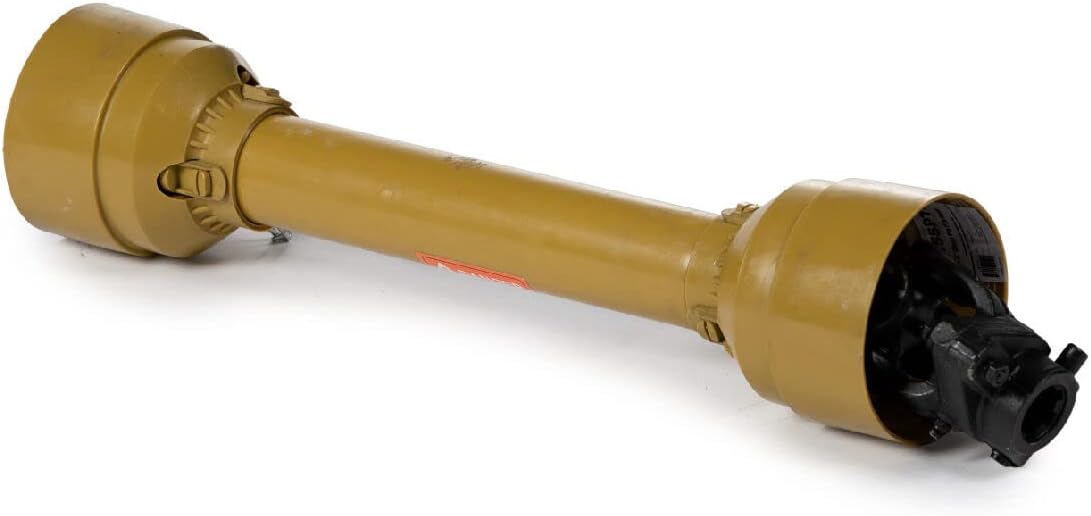
Details: Titan Attachments 31.5″ Collapsed Length PTO Shaft, Shear Bolt Included, 1-3/8-In. x 6 Spline on Both Ends
Brand: Titan Attachments

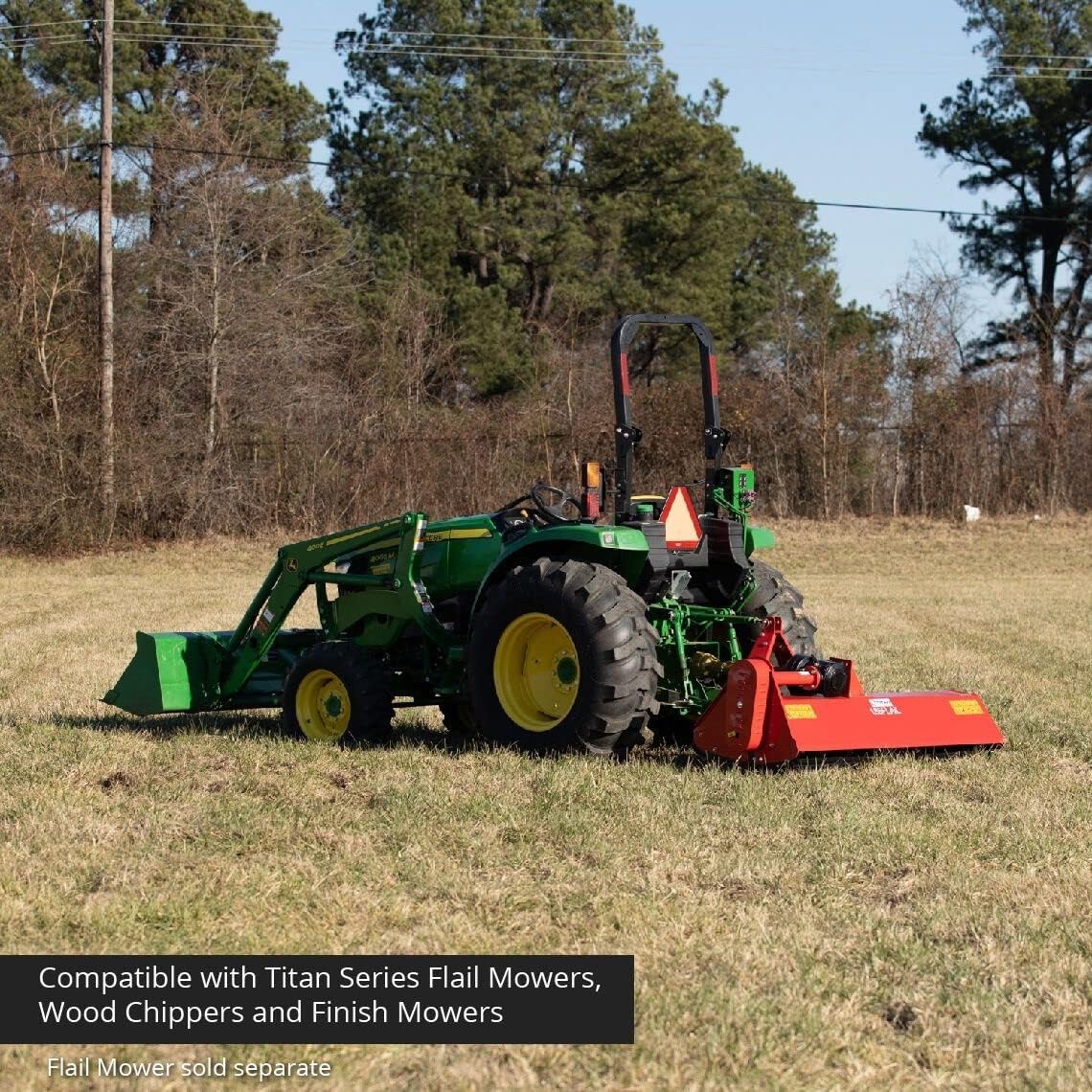
Meet your driveline needs with the Standard Series PTO Shaft featuring a retracted and extended length for different sized implements. The collapsed length measures 31.5-inches, and the extended length measures 43-inches end to end. It is compatible with a tractor power of up to 35 HP at 540 RPM and operates in rotational motion when transferring energy from tractor to implement. Included with the Shaft are the shear bolts and safety chains that attach to the exterior of the PTO Shaft. Easy to install and can be cut to your desired length, this Type 1 Power Take-Off Shaft is compatible with Flail Mowers, Wood Chippers, and Finish Mowers.FEATURES:- Compatible with Titan Series Flail Mowers, Wood Chippers, and Finish Mowers (See list below)- 31.5-inch collapsed length, measured from end to end- 43-inch extended length, measured from end to end- Quick-disconnect 1-3/8-in. x 6 spline on both ends- Shear bolts included- Safety chain includedSPECIFICATIONS:- Max Length: 43-in.- Retracted Length: 31.5-in.- Spline End: 1.375-in. – z6- Tractor Power: 35 HP- PTO Speed: 540 RPM- PTO Type: Shear Bolt PTO- Product Weight: 22 lb.COMPATIBLE WITH:- 191522 – 155FLAIL- 191523 – 175FLAIL- 191524 – 185FLAIL- 198265 – WCBX42S_IM- 198268 – WCBX62S_IM- 191578 – FM48- 191579 – FM60- 191580 – FM72

Advantages
- Products can be returned
- Make sure this fits by entering your model number.
- Compatible with Titan Series Flail Mowers, Wood Chippers, and Finish Mowers
- 31.5-inch collapsed length, measured from end to end
- 43-inch extended length, measured from end to end
- Quick-disconnect 1-3/8-in. x 6 spline on both ends
Notice
- Is an online purchase
- Delivery may be delayed in some areas.
Buyer Guide Tow-Behind Lawn Mowers
When it comes to choosing a 3D scanner, there are many factors you need to consider, including your budget, the type of 3D scanner that suits your needs, the scanner’s accuracy, and the scanner’s portability.- Budget. The more a scanner costs, the more features it will have. Therefore, it’s best that you start with a budget in mind before shopping around.
- Accuracy. The scanner’s accuracy varies by manufacturer, but generally speaking, the more resolution a scanner has, the more accurate and photorealistic the 3D images will be.
- Portability. Portable scanners tend to be larger and heavier, while desktop scanners are lightweight and portable.
- Software. Some 3D scanners come with their own software, while others work with specific CAD software.
- Hardware. The hardware of a scanner is the part that is used to make 3D digital models.
How to choose Tow-Behind Lawn Mowers
If you work in an engineering group, choosing a 3D scanner can be tricky. There are a variety of different types of 3D scanners available, and choosing one requires a bit of research and consideration.- Magnetic or laser scanning? Magnetic scanning uses a focused magnetic field to create a 3D scan of the object. Laser scanning uses light or other electromagnetic radiation to create a point cloud of the object’s surface.
- What type of data is scanned? Most scanners offer at least one type of data a two-dimensional (2D) height map, a texture map, a point cloud, or a mesh model. When scanning an object with a 3D scanner, you should decide which type of data is the most important to you and your project.
- Do you need to texture your scan? If youre scanning an object with a rough, rough texture, you might not need to create a mesh model. However, if youre scanning an intricate object, such as an intricate piece of jewelry, you might need to create a mesh model of the object.
- How much money can you afford to spend? 3D scanners can cost anywhere from $300 to over $10,000. How much are you willing to spend?
- Do you need to scan an object with a non-planar surface? If the surface of an object is curved, your scanner should be able to scan the object. Most scanners wont scan an object with curved surfaces. Some scanners have a curved surface option so that an object can be scanned in a curved manner.
How to maintain Tow-Behind Lawn Mowers
Before purchasing a 3D scanner, its important to know the basics of maintenance and upkeep.- How often should I clean my 3D scanner? Its always a good idea to regularly clean your scanner, but make sure to follow manufacturer instructions for specifics.
- How long will my 3D scanner last? Many people falsely believe that 3D scanners last for years, but in reality, they need to be replaced after a couple of years. Most 3D scanners have a life expectancy of 3 to 5 years.
- How often should I calibrate my 3D scanner? Many manufacturers suggest calibrating your scanner at least once every month. While some people believe that calibrating your scanner helps to improve its accuracy, this isnt always the case.
- Do I need to calibrate my 3D scanner after performing repairs? Many 3D scanners feature an alignment tool that automatically calibrates the scanner after performing repairs.
- Will software updates fix calibration issues? Many 3D scanners have firmware updates that can fix calibration issues.
Related posts:
Review Cordless Grass Shear, Cordless Hedge Trimmer, 2 in 1 Handheld Hedge Trimmer, Grass Trimmers, ...
Review American Lawn Mower Company 1415-16 16-Inch Push Reel Lawn Mower & Sharpening Kit & Grass Cat...
Review LHMYGHFDP Cordless Lawn Mower 48v Electric Wheeled Lawn Mower 15cm Cutting Width Household Ba...
Review 1Pcs 15x6.00-6 15x600-6 15x6-6 for Lawn Mower Tractor
